For school leaders and leaders in education
Character-Based Leadership in Schools
What research means for school leaders in practice — with leadership tools and the workbook for Lower Austria’s annual theme
Leadership is less a matter of choosing the right style than of the person one is while leading. How a school leader listens, admits mistakes, takes difficult decisions and says thank you shapes the culture of a school more than any mission statement. Character-based leadership takes this seriously: it joins a clear idea of the good school with practised routines for everyday leadership — and it rests on research into what makes a difference in schools. This page gathers what Roland Bernhard has developed for school leaders from his research and many years of work with them.
Kurz auf Deutsch: Alle Werkzeuge und das Arbeitsheft auf dieser Seite sind deutschsprachig und stehen Schulleitungen kostenlos zum Download zur Verfügung – unter „Leadership tools“ und „Annual theme Lower Austria“.
The approach
Leading with character: more than a set of skills
Most leadership programmes teach skills: strategy, communication, delegation, time management. They matter — but skills can serve any purpose. Aristotle already drew the line: mere cleverness can reach any goal, practical wisdom aims at the good (Nicomachean Ethics VI 12). The Oxford Character Project has built on this an approach to leadership that asks not only how goals are reached, but which goals are worth reaching, how they should be pursued and what kind of person one becomes along the way (Brooks, Brant & Lamb, 2019; Lamb, Brant & Brooks, 2021).
In schools this matters twice over. The character of a school leader — honesty, fairness, courage, humility, care — shapes the culture of the school directly, because character is passed on above all through example. And forming character is the core of the school’s own mandate: § 2 of the Austrian School Organisation Act asks schools to help young people develop in line with moral, religious and social values and the values of the true, the good and the beautiful. Leading with character is therefore not an extra task on top of everything else — it is the way everything else is done.
Four marks distinguish character-based leadership in schools:
- An image of the good school. It is guided by a picture of a good school that goes beyond performance figures — and it can put that picture into words.
- Leading by example. It does first what it expects of others; the way it listens, takes criticism and admits mistakes shapes the school more than any mission statement.
- Leading through conversation. Staff appraisals, staff meetings and difficult conversations are not administrative acts but the places where character is formed — one’s own and that of others.
- Leading in community. It seeks out friendships of mutual accountability, because nobody leads well alone.
Leadership research describes effective leadership in strikingly Aristotelian terms — as a combination of fierce professional will and personal humility (Collins, 2001). Courage and humility, perseverance and gratitude are not a leader’s private self-improvement; they are instruments of leadership. And they can be learned: like every character strength, they grow through practice, reflection, role models and people who hold us to our word.
From research to your school
What research means for school leaders — concretely
Not a research report, but four consequences for everyday leadership — drawn from Roland Bernhard’s study of highly effective schools in England with the University of Oxford, the twelve-country TEPACE study and the study with more than 80 psychotherapists and school psychologists.
Make teaching quality the one focus everybody knows
In English secondary schools where leaders and teachers perceive a stronger focus on the quality of teaching, students make greater progress than comparable students elsewhere — and the same holds where teachers visit each other’s lessons more often (Bernhard, McDermott, Hasenhüttl, Burn & Sammons, 2024; SQTE project). What makes the difference is the focus itself, not the number of initiatives.
In practice: put the continuous improvement of teaching at the centre of all development work — recommendations and reflection questions from the study.
Make classroom visits a habit of the whole house
The highly effective schools in England improve continuously through evidence-based development of teaching and through lesson observation, including peer observation (Bernhard, 2022). What counts is the conversation after the visit: short, regular visits with a focus agreed beforehand, feedback within 48 hours — and peer observation in pairs, with time protected by the leadership and kept strictly apart from any appraisal.
In practice: peer observation in pairs, with time the leadership protects — what highly effective schools in England do differently.
Your teachers want character education — give it a form
Austrian lower secondary teachers want schools to develop character — most of them rate good character above good exam results — yet an overloaded curriculum and a school system they experience as rigid leave little room for it (Kropfreiter & Bernhard, 2025). Across Europe, parents and teachers share this priority (TEPACE). The task of leadership is to give that shared wish a place in everyday school life.
In practice: the workbook for the annual theme — four questionnaires and two ready-made staff-meeting modules: Leadership und Charakterbildung.
Resilience grows in relationships — and teachers need support too
Psychotherapists and school psychologists across Austria name relationships and a friendly school culture with clear rules as the foundation, followed by life skills taught on purpose and support for teachers’ own mental health: whoever is exhausted can hardly be a role model (Cataldo-Schwarzl & Bernhard, 2025).
In practice: three modules for school leaders — culture, everyday school life, self-reflection: the guide · the project.
Leadership tools
Tools for everyday leadership — free to download
Two tools for leading yourself, and research briefs and a guide for developing your school. Each takes one principle or one body of research and makes it usable at your own school — with a short explanation, concrete steps or recommendations, and questions for reflection in the leadership team, the steering group or the whole staff. Roland Bernhard wrote them for school leaders, some of them with colleagues; all are in German.
Choose one
Not all at once. Start with the tool that touches your most pressing question this term.
Try it on yourself
Go through the tool on your own first — its self-checks and questions apply to the leader before they apply to anyone else.
Take it into a conversation
With a partner, your steering group or in a staff meeting: conversation guides and reflection questions work best in a protected half hour. You do not lead the conversation — you hold the frame.
Agree on a follow-up
End with one small first step and a date to look again. Without a follow-up it remains a good conversation; with one it becomes practice.
Leading yourself
Character and self-management: where all leadership begins
Mut und DemutCourage and humility — character strengths for leaders
Based on Jim Collins’ Level-5 study, James L. Anderson and Dave Anderson, Aristotle and Thomas Aquinas
The two basic attitudes of effective leadership: fierce resolve for the cause and personal humility. The tool shows what courage and humility look like in a school leader’s week — from addressing a problem within 48 hours to naming the contributions of others — and why humility is not self-denial: its opposites are faint-heartedness and pride.
How to work with it: an eleven-item self-check, then the “window and mirror” protocol — five minutes every Friday for four weeks.
Einflussbereich statt SorgenbereichCircle of influence instead of circle of concern
Based on Habit 1 “Be proactive” in Stephen R. Covey, The 7 Habits of Highly Effective People
Staff shortages, regulations, reforms, expectations: much of what occupies school leaders cannot be influenced directly. The tool sorts concerns into three kinds — directly influenceable, influenceable through others, not influenceable — and shows how language reveals which circle someone is standing in.
How to work with it: a 30-minute coaching conversation with sticky notes, ending in one small step that depends on nobody else.
Developing the school
Research briefs and a guide: findings, recommendations and questions for your school
Unterrichtsentwicklung, Fortbildungen, Elternarbeit und Evidenzbasierung in EnglandWhat distinguishes highly effective from average schools
Project summary of a follow-up to the FWF project School Quality and Teacher Education, with Christina Hasenhüttl, Tiarnach McDermott, Katharine Burn and Pam Sammons (University of Oxford)
A survey of 622 school leaders and teachers from 151 schools in England, analysed against students’ progress: schools with a stronger focus on the quality of teaching achieve significantly greater progress; peer observation among teachers goes together with greater progress; and in highly effective schools, leaders and teachers more often name the will to keep developing as one of a teacher’s most important qualities.
How to work with it: recommendations for school practice, professional development and school development advice, and reflection questions on goals, practical relevance, collaboration, sustainability and the role of leadership.
Stark für die Schule, stark für das LebenModules for school development that fosters resilience and character strengths
With Lena Cataldo-Schwarzl, based on a study with more than 80 psychotherapists and school psychologists — the project
Three modules a steering group can work through step by step: working on school culture — community and friendship; embedding character education and social learning in everyday school life; and prompting self-reflection and personal development. The guide adds guiding questions for taking stock, questionnaires and examples of SMART goals and measures.
How to work with it: a process in six steps (module 1) and five steps (module 2) for the steering group; the free MOOC deepens the background.
Förderung von Dankbarkeit als Schulentwicklungsstrategie für psychische GesundheitFostering gratitude as a school development strategy for mental health
Research brief on Bernhard (2024) in SchulVerwaltung, 4, 121–122
Few character strengths are as closely linked to well-being as gratitude — and gratitude can be learned through practice. The brief gathers school practices that are easy to introduce: “three good things”, gratitude journals and gratitude boxes, public expressions of thanks and gratitude letters.
How to work with it: rituals for everyday school life, ideas for lessons and school-wide projects, parents’ evenings, and reflection questions for the staff.
Zusammenhang zwischen Religiosität und psychischer GesundheitReligiosity and mental health — implications for work with (Christian) schools
Research brief by Roland Bernhard and Peter Stippl (Austrian Federal Association for Psychotherapy) on their working paper “Religiosität, Resilienz und psychische Gesundheit” (2024)
More than 5,000 studies have examined how religiosity and mental health are related. The brief summarises key findings — religious practice can strengthen well-being, life satisfaction and resilience — and encourages Christian schools to draw on this resource carefully and with respect for each student’s freedom: through lived charity, services and the feasts of the church year, and spaces for prayer and reflection.
How to work with it: recommendations for Christian schools and schools with Christian religious education, suggestions for professional development and school development advice, and reflection questions for the school community — including on interreligious dialogue.
Where a tool builds on a published model or on studies — Covey, Collins, the SQTE project or the international research on gratitude, resilience and religiosity — the sources are named in the tool. The tools do not replace the original works.
Lower Austria · school year 2026/27
Annual theme “Leadership and Character Education”
For the school year 2026/27, the Education Directorate of Lower Austria has made “Leadership und Charakterbildung” — leadership and character education — the annual theme for all schools of the province. The theme builds on the work of the Austrian Character Initiative; Roland Bernhard accompanies it academically.
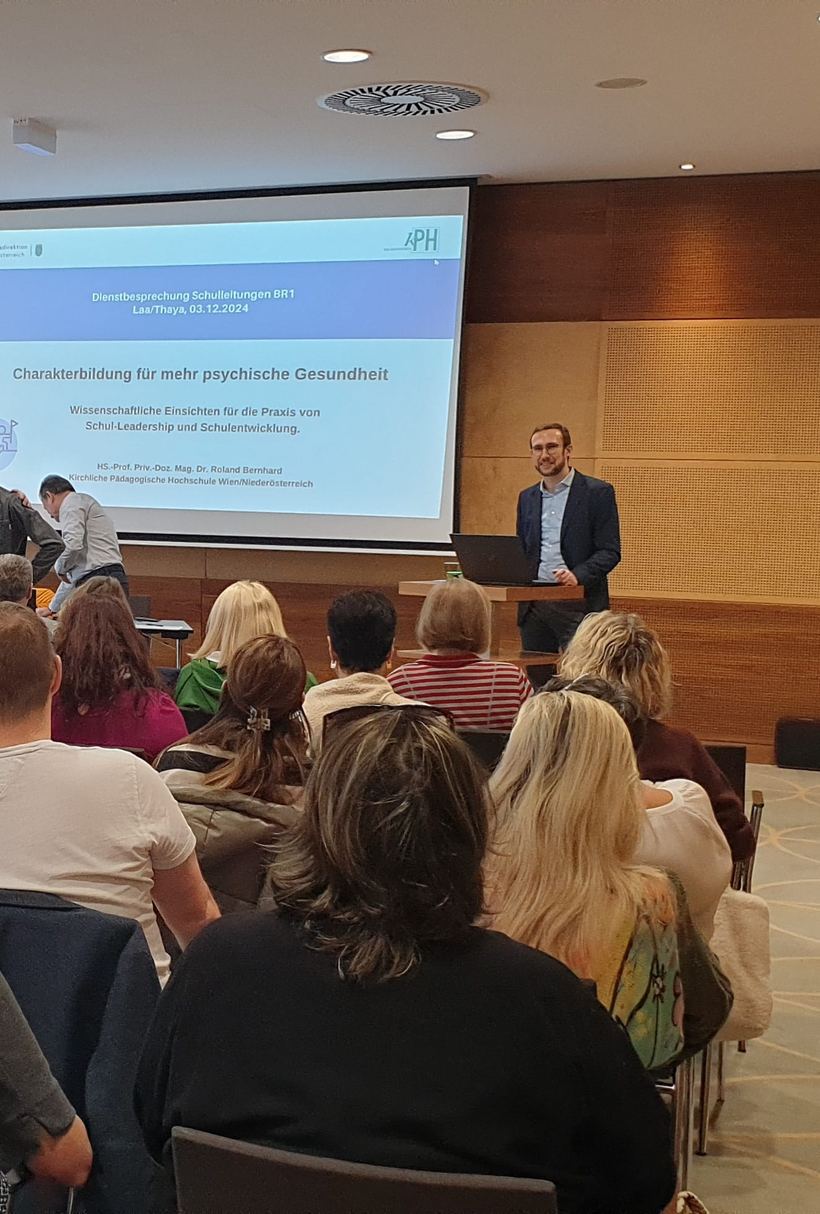
It is carried by those who lead the school system. Roland Bernhard met several times with all school quality managers of the Education Directorate and has spoken to school leaders on numerous occasions; schools can draw on many offers to put the theme into practice.
For school leaders he wrote the workbook Leadership und Charakterbildung, so that every school can translate the theme into its own school development: the primary edition is available, the editions for lower and upper secondary will follow. The leadership tools on this page complement it.
How a school can work with the annual theme
Kick-off
Staff-meeting module “Our language of strengths” (90 minutes): opening with gratitude, three core statements, a partner interview, choosing four to six shared strengths.
Take stock
Questionnaires for the leadership, staff, children and parents (about two weeks), then the staff-meeting module “Where do we stand?” (90 minutes).
Two or three priorities
Few, concrete and visible — in school culture, teaching or real responsibility; the free MOOC works as shared in-school training, one lesson a week.
Look again
An interim review around February and a short repeat survey in May or June: visible progress, however small, fuels the second year.
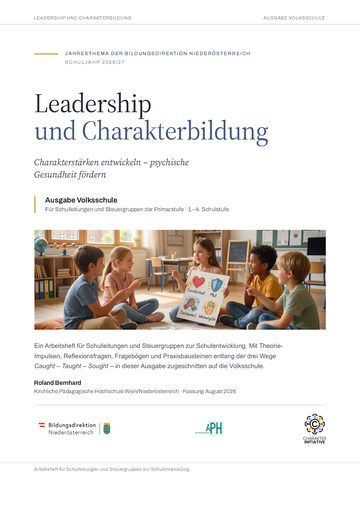
The workbook for the annual theme
Leadership und CharakterbildungCharakterstärken entwickeln – psychische Gesundheit fördern
Understanding, reflecting, acting: eight chapters of foundations, four questionnaires with an evaluation grid, two ready-made staff-meeting modules, building blocks for culture, teaching and engagement with a focus on gratitude, posters and photocopiable templates — down to a letter to parents about the annual theme.
Learning together
Where school leaders can go deeper
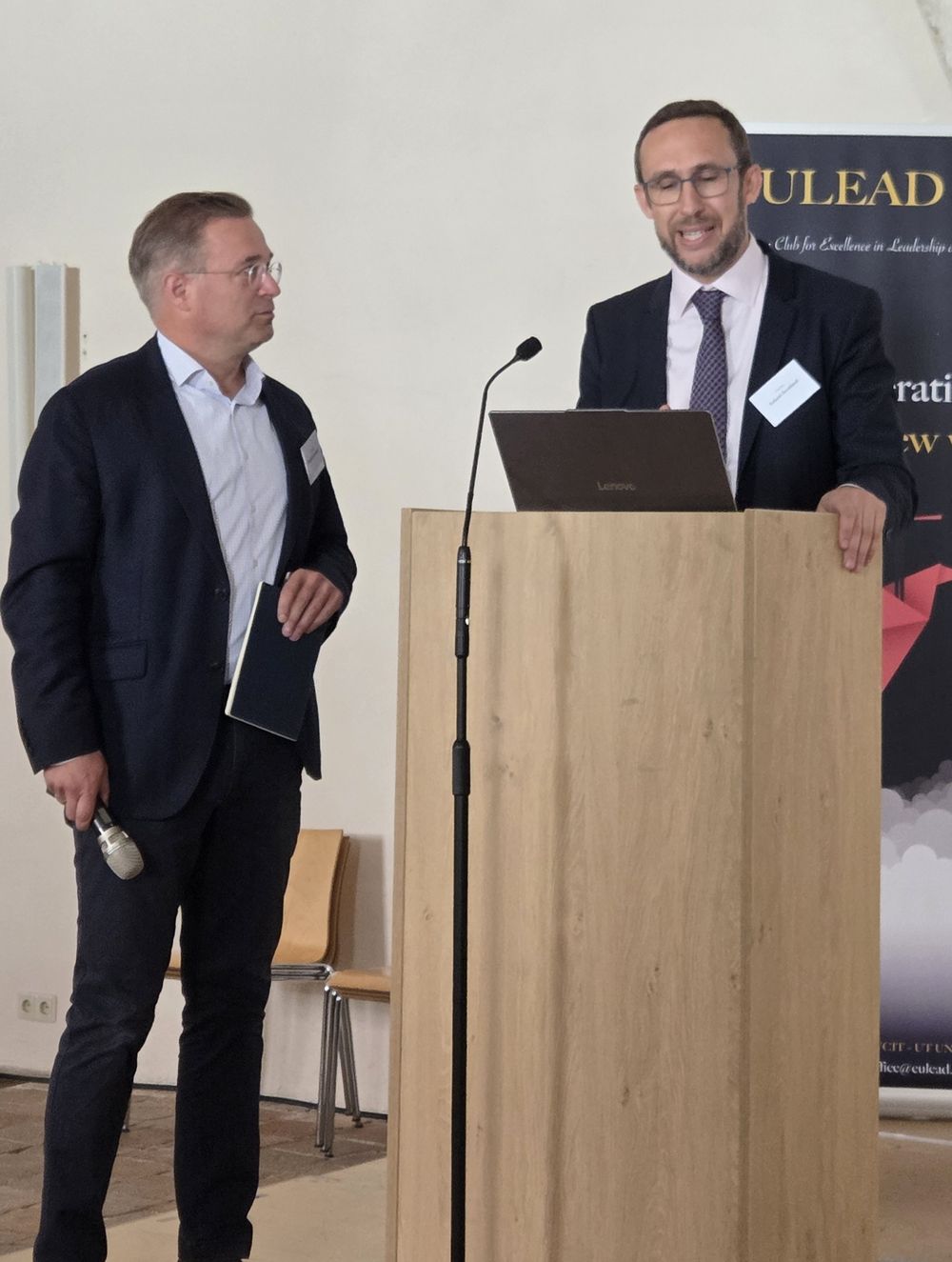
Every summer since 2021 (since 2024 at Lilienfeld Abbey), under the direction of Roland Bernhard: leaders from education, business and civil society. In 2026 more than 100 participants worked on character-based leadership — “Making others great”, with executive coach Matthias Ehrhardt. More →
“Schulische Persönlichkeitsbildung für psychische Gesundheit”: online, 6 ECTS, one semester from February 2027 — for teachers and school leaders, with a supervised practice project at their own school (in German). Course page →
Fifteen lessons with short videos and ready-to-use materials on courage, self-regulation, gratitude and honesty — ideal as shared in-school training, one lesson a week (in German). iMooX →
Talks, workshops and conference inputs on character-based leadership for school leaders, school quality managers and education authorities — on request. Get in touch →
Further reading
By Roland Bernhard and colleagues
Other works cited on this page
In one sentence
“Leadership without character turns into technique or the exercise of power; character education without leadership remains a matter of chance.”Roland Bernhard, Leadership und Charakterbildung (2026) — translated