Research and practice · 2025–2026 · with the European Office of the Vienna Education Directorate
Leadership for Resilience and Character Strengths
What psychotherapists and school psychologists advise schools — and how school leaders can act on it
How can schools help young people become mentally strong? Roland Bernhard and Lena Cataldo-Schwarzl asked those who work every day with the psychological strain on children and adolescents: psychotherapists and school psychologists across Austria. From their answers and the international research, they developed three modules with which school leaders and steering groups can start school development for resilience, character strengths and mental health — in cooperation with the European Office of the Vienna Education Directorate and the Austrian Federal Association for Psychotherapy (ÖBVP).
The study
Asking those who see what makes children strong — and what weakens them
The mental health of the young generation in Austria is considered precarious — a joint study by KPH Vienna/Lower Austria and the ÖBVP pointed to this in 2023 as well. Since every young person goes through school, school is the one place where resilience and character strengths can be fostered systematically. But what actually works?
Roland Bernhard and Lena Cataldo-Schwarzl, both at KPH Vienna/Lower Austria and both working as external experts for the European Office of the Vienna Education Directorate, chose an unusual route: instead of asking schools first, they asked those who look at school from the outside and know children’s needs at first hand — psychotherapists working with children and adolescents, and school psychologists.
Four questions guided the study: How do these professionals understand resilience, and what makes it grow? Which school measures do they consider particularly effective? Which character strengths should schools foster, and how? And what role does cooperation between schools and psychotherapy play?
How the research was done
In February 2025, open questionnaires went out by e-mail to child and adolescent psychotherapists and school psychologists throughout Austria. 77 detailed responses came back — 63 from psychotherapy, 14 from school psychology — and were analysed with structuring qualitative content analysis. Across two Austrian studies, more than 80 professionals were surveyed; building on this work, Beatrix Faragó carried out a study of her own in Hungary. The research was conducted in cooperation with the ÖBVP. The answers were largely consistent across both countries — and matched what international research on resilience and character strengths has shown for years.
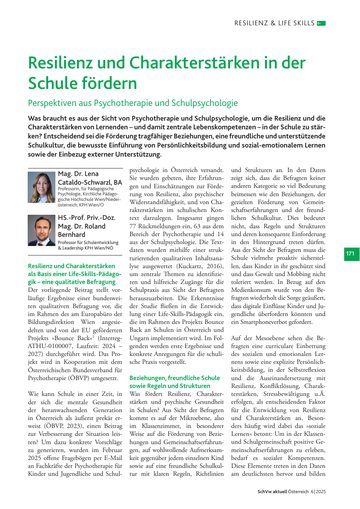
Read the findings
Resilienz und Charakterstärken in der Schule fördern. Perspektiven aus Psychotherapie und Schulpsychologie
Lena Cataldo-Schwarzl & Roland Bernhard · SchulVerwaltung aktuell Österreich 13(6), 2025, 171–172 · in German

What the respondents say
Four messages for every school
Relationships are the foundation
No category carried more weight than relationships, deliberately planned experiences of community and a friendly school culture — with clear rules and structures. Schools must actively ensure that children are protected and that violence and bullying are not tolerated.
Life skills must be taught
Social and emotional learning and explicit character education belong in the curriculum: self-reflection, resilience, conflict resolution, character strengths, coping with stress. Some respondents even called for a subject of its own.
Teachers need support
Teachers’ own mental health is the basis for everything else: regular collegial reflection, supervision where needed and a culture of care for the adults, too. Whoever is exhausted can hardly be a role model.
Schools open up to outside expertise
The responsibility cannot rest on teachers and school leaders alone. Respondents suggest, for example, mental-health days for everyone, staff included — and see mental health not as a fixed state but as something a school can shape.
Many concrete ideas came up as well: morning circles and reflection rounds, buddy systems between older and younger pupils, projects in which children take on responsibility — and, repeatedly, the concern that digital influences overwhelm children, up to calls for a smartphone ban. The key insight: schools can act proactively — mental health can be shaped, individually, as a team and through the structures a school creates.
The model
Three ways children learn for life
The modules follow the framework of the Jubilee Centre for Character and Virtues: character education happens on three levels at the same time — and schools can work on all three.
What children absorb
Children learn above all from what is lived in front of them: how people treat one another, how conflicts are resolved, how much warmth and safety a school radiates. Community, reliable relationships and authentic role models are the soil in which resilience grows.
What children learn on purpose
Some things have to be practised directly, like fractions or vocabulary: dealing with anger, speaking one’s mind without hurting others, resolving a dispute fairly — in a subject of its own, in class-council lessons or as a fixed part of subject teaching.
What children strive for themselves
The most important development happens inside the child. Schools cannot force it, but they can invite it: What are my strengths? What matters to me? Where do I want to go? When pupils take responsibility, outside encouragement becomes an inner attitude.
For school leaders and steering groups
From knowing to doing: three modules
Each module is a building block of its own and follows a clear process: Where do we stand? Where do we want to go? What are the next steps? The modules are not a rigid programme but a flexible framework — to be implemented in full or used as inspiration for a school’s own concept. Download the modules (PDF, 34 pages, in German) ↓
Working on school culture: fostering community and friendship
The foundation: an environment in which pupils feel safe, that they belong and that they are valued. Strong community and real friendships are the result of deliberate design.
Six steps- Take stock (steering group and pupil survey)
- Collect ideas
- Involve the whole staff
- Draw up a project plan with SMART goals
- Evaluate and develop further
- Make it last
Embedding character education and social learning in everyday school life
Life skills are taught explicitly and systematically — in a fixed weekly lesson, across subjects, or both. The free MOOC on character education for mental health provides tried-and-tested methods.
Five steps- Assess where the school stands
- Define learning goals and priorities
- Choose and embed methods and content
- Professionalise and support teachers
- Implement, evaluate, develop further
Encouraging self-reflection and personal development
Children learn to perceive and interpret their own thinking, feeling and acting — the core of “character is sought”, grounded in the idea of practical wisdom (phronesis).
Five areas of reflection- Perceiving one’s own thoughts and feelings
- Reflecting on actions and consequences
- Setting personal goals
- Weighing decisions in the light of values
- Making reflection part of the learning culture
Every module comes with
Getting started
Start where the need is greatest
Choose a module
Start with the module that fits your current priority: community, character education or self-reflection.
Reflect as a team
Use the guiding questions and materials to take stock together with the staff or a steering group.
Adapt and plan
Decide which ideas suit your school and draw up a realistic implementation plan.
Try out and anchor
Implement selected measures, evaluate their effect and build what works into routines and the school programme.
How the project developed
From the first idea to the modules
First talks on a life-skills pedagogy for Austria and Hungary
At the 1st Austrian Forum for Peace in Schlaining, Roland Bernhard — once together with Lena Cataldo-Schwarzl — outlines how a life-skills pedagogy for Austrian and Hungarian schools could be developed in international cooperation.
An EU project at the European Office of the Vienna Education Directorate
The European Office starts a project to promote life skills and resilience in primary and lower secondary schools in the Austrian–Hungarian border region (Interreg VI-A Austria–Hungary, February 2024 to January 2027). Roland Bernhard contributed substantially to its design and funding application; the study was designed in December 2024.
Nationwide survey
Open questionnaires go out to psychotherapists and school psychologists across Austria; 77 detailed responses come back.
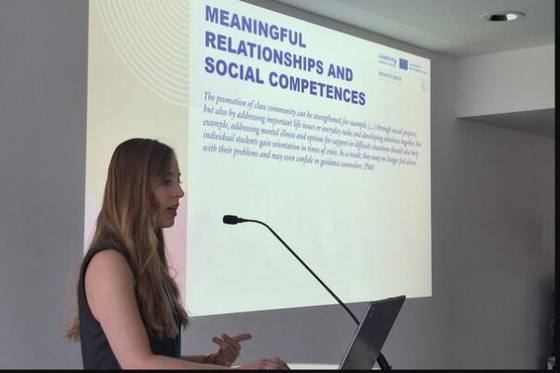
First findings at the ECVA Conference in Vienna
Lena Cataldo-Schwarzl and Roland Bernhard present “Developing a Life-Skills Pedagogy for Schools in Austria and Hungary: Insights from Psychotherapists and Psychologists” to an international audience.
Published in SchulVerwaltung aktuell
First findings appear in an issue of the journal edited by Roland Bernhard and Katharina Hanyka (6/2025) — alongside contributions by Kurt Nekula, who leads the EU project at the European Office, and Peter Stippl. Read the article (PDF) →
The modules for school leaders
“Strong for school, strong for life”: three modules for school development that fosters resilience and character strengths — free for every school. A longer guide, co-authored with Beatrix Faragó, is in press. The modules (PDF, in German) →
Publications and talks
The takeaway
School as a place where resilience and character grow
Through sustaining relationships and a friendly school culture, clear rules and structures, character education and social learning anchored in the curriculum, strengthened mental health among teachers and openness to outside expertise, school can become a place where personal development succeeds — for pupils and teachers alike.
“What matters is the insight that schools can act proactively and that mental health can be shaped — individually, as a team and through structural conditions within the school.”Cataldo-Schwarzl & Bernhard, SchulVerwaltung aktuell Österreich 6/2025 (translated) · read the article