Research project · 2026–2031 · KPH Vienna/Lower Austria with Teach For Austria
Kompass School of Character Favoriten, Vienna
A proof-point school for excellent teaching and character education in Vienna
In September 2026 a new middle school opened in Favoriten, Vienna’s tenth district. It mainly admits children who start secondary school with considerable learning gaps and grow up in difficult socio-economic circumstances. The Kompass School of Character Favoriten, Vienna sets out to show that these children can go far — academically and as people — when teaching is consistently excellent and character education is part of the school’s explicit mission. KPH Vienna/Lower Austria accompanies the school scientifically from 2026 to 2031.
How the school came about
Research and practice, joining forces
In the FWF project School Quality and Teacher Education (SQTE, 2019–2023), carried out with the University of Oxford, Roland Bernhard examined how schools in some of England’s most disadvantaged areas — above all in London — became outstanding. What these schools had in common was unspectacular and demanding at once: an uncompromising focus on the quality of teaching, school leaders who treat teaching as their core business, continuous feedback and practice for teachers — and a school culture in which character is deliberately cultivated. Again and again, the school leaders he interviewed pointed to Teach First as an organisation that knows these approaches particularly well. That is how he came across its Austrian counterpart in the Teach For All network, Teach For Austria.
Teach For Austria had been working with these approaches for many years — with precisely described teaching techniques, practice and feedback in the preparation of its fellows. Aron Marton, who joined Teach For Austria as a fellow in 2016, had long used them in his own classrooms and in school development at his school.
So the two sides joined forces — research and practice. KPH and Teach For Austria developed a joint in-service series on classroom leadership, taught by Aron Marton, Cecilia Cadman and Roland Bernhard; it became unusually popular, and the weekly magazine news reported on it in February 2025. In 2025 the four authors Roland Bernhard, Cecilia Cadman, Verena Hohengasser and Aron Marton published their shared experience: an article on deliberate practice in teacher education (full text, open access).
The Kompass School of Character Favoriten, Vienna grows out of this collaboration. Teach For Austria initiated the school; its concept was developed by Verena Wohlers, Sophie Lonyay and Aron Marton, who leads the middle school; KPH Vienna/Lower Austria accompanies it scientifically.
“Our overarching goal is to build a so-called proof-point school — to show that in the tenth district, too, children from socio-economically disadvantaged homes can have truly great educational paths.”Aron Marton, co-founder and head of the middle school
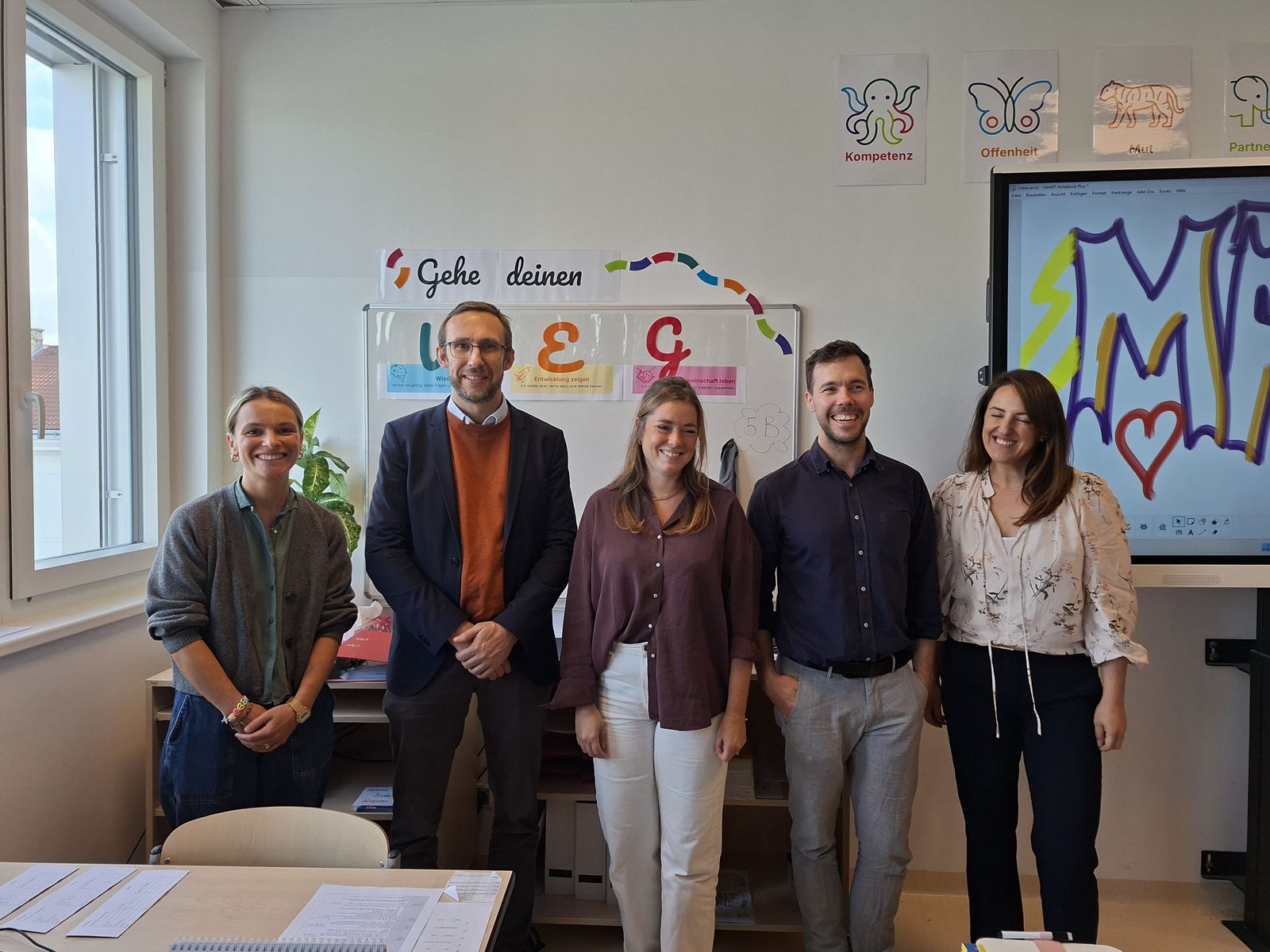
The school’s model
Two pillars: excellent teaching and character
Both pillars rest on one conviction: children who start from behind deserve high expectations — and a clear, reliable structure in which they can meet them.
Excellent teaching
All teachers work with the same, precisely described teaching techniques and routines. Lessons open with a short retrieval task, every child has a mini-whiteboard to answer on, partner talk follows clear rules. Pupils do not have to learn different rules for every teacher — so their attention stays on learning.
The doors are open. Colleagues and the school development team visit lessons unannounced, several times a week, and give short, concrete feedback; every teacher has a weekly feedback conversation, and techniques are rehearsed until they sit. The teachers were chosen for their appetite for feedback: in the selection process, candidates showed their teaching (in class or on video), received feedback and practised on the spot.
The aim: calm, focused classrooms — not through harshness, but because everything is so well organised that disciplinary problems rarely arise.
Character education
The school is built on seven values whose initials spell its name. Each value has an animal that explains it to ten-year-olds in stories — from the octopus for competence to the tiger for courage.
In the spirit of the Jubilee Centre’s framework, character is both caught and taught: caught from adults who live the values every day — on four mornings a week, Aron Marton greets every child at the door with a handshake — and taught in a dedicated character education lesson that all pupils attend, on themes such as identity, tolerance and independence.
Good conduct is recognised in front of the class: children earn ‘milestones’ not for what is expected of everyone, but for going beyond it — for discovering knowledge, showing growth and living community (in German, the initials spell WEG, ‘the way’). The hope, as Verena Wohlers puts it, is that doing the right thing becomes a habit — and cool.
The seven values
In their own words
Why character belongs at the heart of this school
Academic progress is one thing; the other is character formation. How do I become a good person? How can I deal well with my own feelings? How do I get on well within a community?
Teaching is always a transmission of values. If you don’t do it deliberately, you simply end up with other values — perhaps ones you don’t want. We want to shape this process actively.
The goal is the same for everyone: that they become competent young people who can choose — do I want an apprenticeship, do I want to study, how do I want to shape my life? The finishing line is the same, but the starting line is so different.
Quotations translated from German and lightly edited.
Milestones
How research and practice came together
SQTE: what highly effective schools do
With the University of Oxford, Roland Bernhard studies how schools in disadvantaged areas of England, above all in London, became outstanding. Their school leaders point to Teach First as an organisation that knows these approaches particularly well.
Years of practice at Teach For Austria
Teach For Austria prepares its fellows with precisely described teaching techniques, practice and feedback. Aron Marton, who joined as a fellow in 2016, works with these approaches in his classrooms.
A State Prize for Aron Marton’s school
The Modulare Mittelstufe Aspern, where Aron Marton teaches and helps to drive school development, wins the Austrian State Prize for Innovative Schools 2022/23.
A joint training series
KPH and Teach For Austria develop a modular in-service series on classroom leadership, taught jointly by Aron Marton, Cecilia Cadman and Roland Bernhard. The first round ends in January 2024 with very positive feedback and the series continues; in February 2025 the weekly magazine news reports on it.
Speaking to 120 school leaders in Vienna
At the first ‘Pädagogisches Werkstattgespräch’ at the Vienna Education Directorate, Roland Bernhard, Aron Marton and Cecilia Cadman speak to 120 principals and quality managers about teaching quality.
A joint publication
Roland Bernhard, Cecilia Cadman, Verena Hohengasser and Aron Marton describe deliberate practice in teacher education — drawing on highly effective English schools, Teach For Austria and KPH. Full text (open access)
The school takes shape
Teach For Austria decides to initiate a school; a site is found in Favoriten, where a new middle school is being built onto a primary school. Verena Wohlers, Sophie Lonyay and Aron Marton develop the concept and, from spring 2026, prepare the new team — on training Saturdays, in a summer bootcamp and in two weeks of joint preparation before the start.
The Kompass School of Character Favoriten, Vienna opens
The school starts with two first-year classes; two more follow each year, up to eight. Aron Marton leads the middle school, which forms a school cluster with the primary school on the same site.
Accompanying research
KPH Vienna/Lower Austria accompanies the school for five years, led by Roland Bernhard and Denise Hofer.
The accompanying research
Looking closely — over five years
From 2026 to 2031, KPH Vienna/Lower Austria accompanies the Kompass School of Character Favoriten, Vienna with research, on the basis of a cooperation agreement with Teach For Austria. The project is led by Roland Bernhard and Denise Hofer, who has long experience in accompanying and researching urban middle schools and specialises in the question of how school and professional development can have lasting effects.
The accompanying research follows the first two year groups from year 5 to year 8, together with the whole staff. It asks how the pupils develop (in their learning, above all in reading, German and mathematics, and in their wellbeing and sense of belonging), how the teachers grow professionally over the years, how parents experience the school, and under which conditions the school’s approach works and what other schools could take from it.
The accompanying research observes and describes; it publishes no results on individual children or teachers and no rankings. Results will be shared in annual reports, academic publications and practice-oriented formats — so that the Kompass experience can help other schools in challenging circumstances.
At a glance
- Design
- Mixed-methods longitudinal study at one school
- Duration
- 2026–2031
- Participants
- Two year groups from year 5 to year 8; teachers, school leadership, concept team and parents
- Focus
- Learning progress · wellbeing and belonging · teaching quality · teachers’ professional growth · character education · parents
- Project leads
- Roland Bernhard and Denise Hofer, KPH Vienna/Lower Austria
- Partner
- Teach For Austria
- Funding
- Own resources of the participating institutions
Background reading
Publications from research and practice
What it is for
A school others can learn from
The Kompass School of Character Favoriten, Vienna is meant to show what is possible — and to make it learnable for others. Its concept is being documented so that schools that want to follow can do so, and the accompaniment will show what works, at what cost and under which conditions.
“It should not remain an island project — ideally, it should spread.”Verena Wohlers, co-founder