Research project · 2023–2026 · European Character and Virtue Association
TEPACE
Teachers’ and Parents’ Perspectives on Character Education in Europe
What do the adults closest to children — their parents and their teachers — actually think about the moral formation of young people in school? TEPACE asked them — 10,909 of them, in eight European countries so far. The answer is clearer than most policy debates assume: the two groups want the same thing, and each believes the other does not.
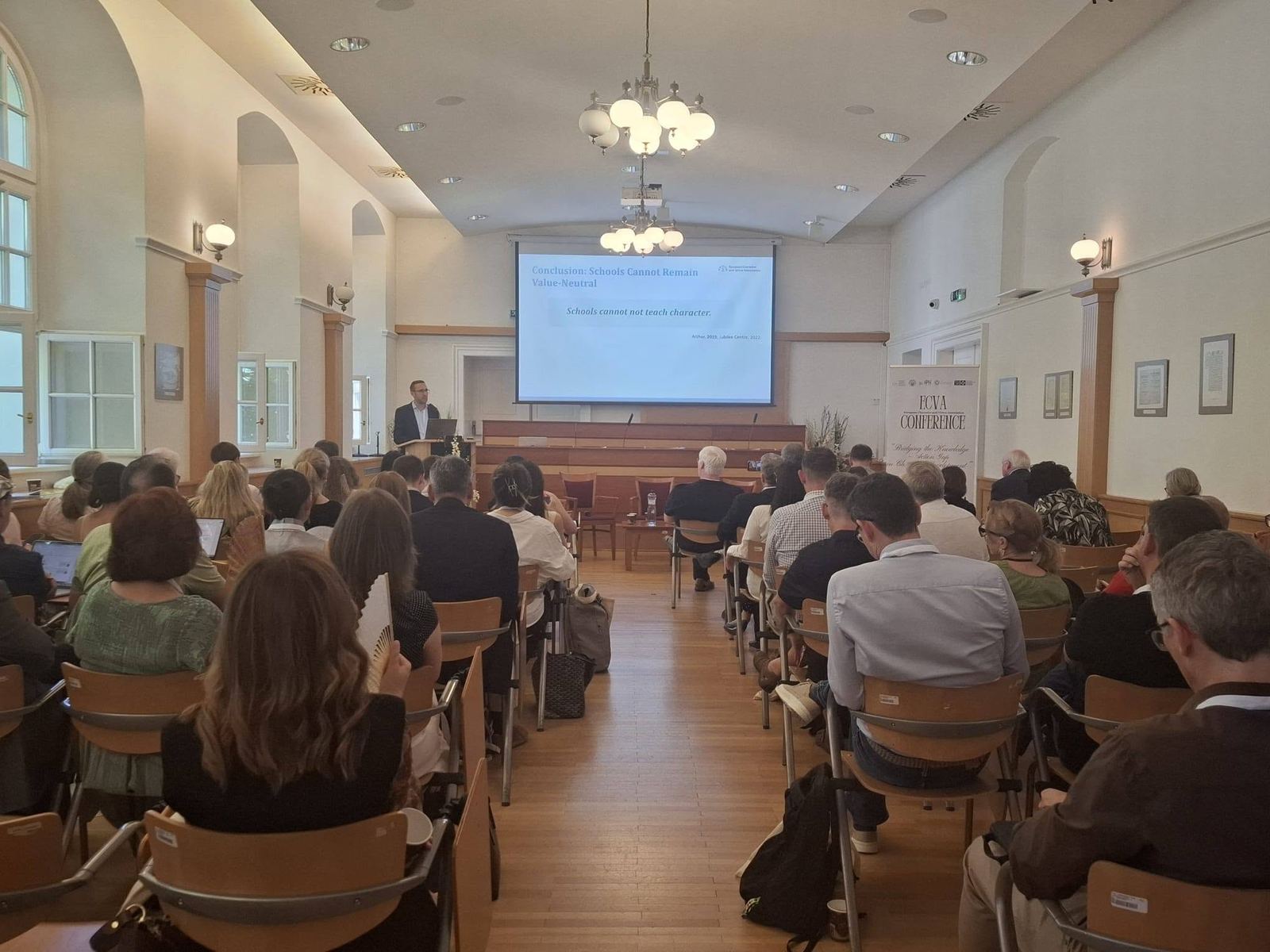
Presenting the main results of TEPACE to around 100 researchers at the ECVA Conference in Trnava, June 2026
Where the question came from
A finding from England that would not let us go
In 2022, Tom Harrison and colleagues at the Jubilee Centre for Character and Virtues in Birmingham published a survey of parents and teachers across England. Two things stood out. When asked directly, both groups rated the development of good character as more important than academic attainment. And each group systematically underestimated how much the other valued character. Much of the hesitation around character in schools, it seemed, rested on a misperception rather than on any real disagreement about what schools are for.
Was that an English peculiarity, shaped by an unusually accountability-driven school culture — or something European? In 2023, Roland Bernhard, Eva Müllauer and Evelyn Kropfreiter at KPH Vienna/Lower Austria, with Tiarnach McDermott at the University of Oxford, translated and adapted the English instruments and repeated the study in Austria. The Austrian data confirmed the English pattern. Evelyn Kropfreiter completed her doctorate within this study; its results appeared in the Journal of Moral Education and the Journal of Character Education.
When the Austrian team presented its first results at the ECVA Conference in Madrid in June 2023, colleagues from several countries asked whether they could run the same study at home. Within months the replication had become a consortium — a loose federation of national teams sharing one instrument, one conceptual framework and one purpose. Roland Bernhard leads it; Martin Brestovanský, Verónica Fernández-Espinosa and Tom Harrison form the leadership team, all board members of the European Character and Virtue Association.
What the data show
Four findings from 10,909 parents and teachers
The pooled analysis covers Austria, the Czech Republic, England, Germany, Latvia, Poland, Slovakia and Spain. To our knowledge it is the largest comparative dataset of its kind currently available for continental Europe.
A near-universal mandate
93.3 % of parents and 93.7 % of teachers agree or strongly agree that character education in schools is very important (six countries).
The perception gap
Teachers think 54.5 % of parents put attainment above character. In reality, 9.2 % do — a six-fold overestimate. Parents make the same mistake about teachers (seven countries).
No trade-off
91.1 % of teachers and 87.1 % of parents expect a greater focus on character education to improve pupils’ academic attainment. Hardly anyone expects harm.
Confident — but not everywhere
79.3 % of teachers feel confident delivering character education (six countries). Nearly a fifth of the variance lies between countries: where teachers work matters.
Who thinks the other side prefers attainment over character?
Presumed by the other group versus the share who actually hold that view. Seven countries.
First line: what teachers presume about parents (54.5 %) versus what parents actually say (9.2 %). Second line: what parents presume about teachers (37.7 %) versus what teachers actually say (5.9 %). The project calls this, following Harrison and colleagues, the ascription–actuality gap.
Which virtues matter most?
Share choosing each virtue among the three most important. Parents n = 7,969, teachers n = 2,639.
The sharpest difference is confidence: parents put it first, teachers seventh. Teachers lead with honesty and civility, and value curiosity far more than parents do. Taken together, the top choices span all four virtue categories of the Jubilee Centre framework — moral (honesty), intellectual (good judgement), civic (civility) and performance (confidence, resilience).
One more number worth knowing: asked what matters most when choosing a school, 82.6 % of parents named the quality of teaching and 66.3 % the values the school stands for. Examination results came far behind, at 13.9 %.
The consortium
A network that grew out of conversations, not a call for proposals
The consortium brings together 47 researchers in twelve countries. Each national team runs its own fieldwork, translation and ethics; the consortium decides the common core of the instrument and the pooled analyses together, in regular video meetings and at the annual ECVA conferences. Eight countries contributed data to the first comparative report; three more are collecting data and a fourth team is being set up.
In the first comparative report · eight countries
Austria
- Roland Bernhard
- Evelyn Kropfreiter
- Eva Müllauer
- Julia Lechner
Czech Republic
- Jan HáblUniversity of Hradec Králové
- Alžběta VaňkováPalacký University Olomouc
- Ivo JirásekPalacký University Olomouc
- Barbora BačíkováPalacký University Olomouc
England
- Tom Harrison
Germany
- Ines Weber
- Sarah Natalie Krejzaproject assistant
Latvia
- Manuel Joaquín Fernández González
- Irina Maslo
- Tamāra Pīgozne
- Svetlana Surikova
Poland
- Paweł Sikora
- Natasza Szutta
- Artur Szutta
- Jagoda Mielczarek
Slovakia
- Martin Brestovanský
- Andrej Rajský
- Marek Wiesenganger
- Romana Martincová
- Lucia Kočišová
- Veronika Javorková
- Anna Sádovská
Spain
- Verónica Fernández-EspinosaUniversidad Francisco de Vitoria, Madrid
- Marta Velázquez GilUniversidad Francisco de Vitoria, Madrid
- Paloma Redondo-CorcobadoUniversidad Internacional de La Rioja
Fieldwork under way or in preparation · four countries
Croatia
- Anita CalvertUniversity of Kent Academies Trust · Philosopher’s Mind
- Ivan KoprekUniversity of Zagreb
- Ante BelićUniversity of Zagreb
- Dan ĐakovićUniversity of Zagreb
- Marija DžinićUniversity of Zagreb
- Marijana KolednjakUniversity of Zagreb
- Mikolaj MartinjakUniversity of Zagreb
Hungary
- Beatrix Faragó
Iceland
- Ingimar Ólafsson WaageIceland University of the Arts, Reykjavík
- Sigríður IngadóttirUniversity of Akureyri
- Íris Hrönn KristinsdóttirUniversity of Akureyri
- Garðar ÁrnasonUniversity of Akureyri
- Gunnar GíslasonUniversity of Akureyri
Italy
- Maria Silvia VaccarezzaUniversità degli Studi di Genova
- Claudia NavariniUniversità Europea di Roma
- Michel CroceAretai – Center on Virtues
- Martina Piantoni
Milestones
From a replication to a European evidence base
The English study
Tom Harrison and colleagues at the Jubilee Centre survey parents and teachers across England and describe the ascription–actuality gap for the first time.
Replication in Austria
The Austrian team adapts the instruments and surveys teachers and parents. First results are presented at Oriel College, Oxford (January) and at the ECVA Conference in Madrid (June) — where the consortium is born.
Fieldwork across Europe · symposium in Rome
National teams translate and run the survey. At the ECVA Conference in Rome, Roland Bernhard organises the international TEPACE symposium with Verónica Fernández-Espinosa and Tom Harrison — 23 contributors from eight countries.
First comparative results in Oxford
The consortium presents preliminary comparative findings at the Jubilee Centre’s annual conference, Oriel College, Oxford.
Seven-country comparison in Vienna
At the ECVA Conference in Vienna — organised by Roland Bernhard, 130 participants from 23 countries — the team presents perceived priorities in character and attainment across seven countries.
Publications and policy
Country studies appear in Slovakia, Spain, the Czech Republic, Latvia and Austria. The Spanish team presents the results to policymakers in Madrid. Lower Austria makes character education and leadership the annual theme for all its schools in 2026/27.
Keynote in Zagreb
“A mandate for character education”: Roland Bernhard, Martin Brestovanský, Verónica Fernández-Espinosa and Tom Harrison present the evidence on shared priorities at the international symposium Character Matters, University of Zagreb.
Main results, policy panel and the Trnava Declaration
At the ECVA Conference in Trnava — “Bridging the Knowledge–Action Gap in Character Development” — the main results are presented to around 100 researchers. A policy panel with representatives of the Slovak Ministry of Education, a former minister, the Global Character Alliance and ECVA discusses the implications, and the Trnava Declaration on Character Education is launched.
Final report and the next wave
The final report of the first wave is completed. The comparative manuscript is under review at the British Journal of Educational Studies. Croatia, Iceland and Italy continue collecting data and a Hungarian team is being set up; the consortium is preparing a longitudinal and qualitative second phase.
From evidence to policy
Where the findings have already changed something
A whole region takes up the theme
Presented to the Education Directorate of Lower Austria — among others to around 100 school quality managers and 160 school leaders — the TEPACE findings contributed to a major implementation step: character education and leadership became the annual theme for all schools in Lower Austria in the school year 2026/27. Roland Bernhard wrote the accompanying workbooks for school leaders. Workbook and tools →
Character standards in the national curriculum
The Slovak team used the national TEPACE findings to support the implementation of character-education standards in school practice through Slovakia’s new national curriculum, and presented the project at a conference of the National Institute for Education and Youth.
Madrid, and a declaration for Europe
In November 2025 the Spanish team presented the findings to policymakers of the Community of Madrid with a dedicated dossier. In June 2026 the Trnava Declaration on Character Education, launched at the ECVA conference, called on European institutions, education authorities, schools and universities to recognise character education as a fundamental dimension of excellent education.
Europe, on the evidence of the TEPACE data, already seems to have the social consensus it needs to move this agenda forward. What it needs now is the individual, institutional and political will to act on it.TEPACE Final Report, 2026
Publications from the project
Twelve published, six on the way
National teams publish their own country studies; the comparative results are written up by the whole consortium. Published, accepted and in-press outputs to date:
Comparative
Austria
Country studies
In preparation or under review: further Czech, Italian, Latvian and Austrian studies, among them a paper on the Austrian parents’ survey submitted to the Journal of Beliefs and Values.
How the study was done
One instrument, twelve school systems — and an honest note on comparability
TEPACE is a comparative survey study. Two questionnaires — one for teachers, one for parents — combine Likert-scale items with forced-choice ranking tasks and were developed iteratively by the consortium in dialogue with the Jubilee Centre’s instruments, with attention to translation equivalence across languages. Conceptually, the study draws on the neo-Aristotelian framework of the Jubilee Centre for Character and Virtues, which distinguishes moral, intellectual, civic and performance virtues.
Teachers were recruited through school networks, teacher associations and school leaders; parents typically through schools that distributed an invitation on the team’s behalf. Participation was voluntary and anonymous, and each team obtained the ethical clearances of its own institution and complied with the GDPR. Pooled analyses use multilevel models that account for the clustering of respondents in countries.
What the data can and cannot say. TEPACE is not a centrally commissioned survey with a uniform protocol and matched quotas. It is a federation of national studies that share a common core but differ in fieldwork timing, sampling frame, response rate and the range of optional items. The samples are not representative, and generalisation is limited accordingly. Pooled figures are reported only for items administered identically, and the report states which countries contributed to each figure. We would rather say this plainly than let the size of the dataset suggest a precision it does not have.
At a glance
- Design
- Cross-sectional comparative survey; teacher and parent questionnaires
- Sample
- 10,909 respondents in eight countries; 78 % of responding parents and 77 % of teachers are women
- Framework
- Jubilee Centre Framework for Character Education in Schools
- Analysis
- Descriptive comparison; logistic and cumulative link mixed models with respondents nested in countries
- Funding
- Foundation funding; the national teams contribute their own resources
- Coordination
- European Character and Virtue Association
What comes next
A second wave, and the step from beliefs to practice
The first wave answered descriptive questions in substantial detail. It cannot yet show how beliefs change over time or respond to specific practices. The consortium is therefore preparing a longitudinal follow-up in a subset of TEPACE schools, a comparative analysis of the qualitative material several teams collected alongside the surveys, and an openly published, revised version of the instrument.
The larger task is practical. Research reports do not reform schools; practitioners do. Through the annual ECVA conferences, teacher education and the Austrian Character Initiative, the findings are being turned into training, materials and school development — including the workbooks written for the annual theme in Lower Austria.